Sunday, October 7, 2007

Loi Krathong Festival


“Loi Krathong” is traditionally performed on the full moon night of the twelfth lunar month, which usually falls on some day in November. The floating of a ‘Krathong' – a banana–leaf cup – is intended to float away ill fortune as well as to express apologies to Khongkha or Ganga, the River Goddess. Some believe that the ritual is meant to worship the Buddha's footprint on the bank of the Narmada River, while others say that it is to pay respect to Phra Uppakhut, one of the Lord Buddha's great disciples.

The Loi Krathong Festival is celebrated nationwide in Thailand, especially where there are rivers, canals or sources of water, with different unique characteristics.

This year, the Tourism Authority of Thailand (TAT) has joint with Educational Institution and Thai Baot Association to present the Electric Float Procession from Taksin Bridge to Rama VIII Bridge and the 12 lighten up buildings and historical sites along Chao Praya River during Loi Krathong Festival.

As for the public, people usually make banana-leaf cups to float them onto the river although there exist some uniquely different aspects in certain communities. For example, the Yi Peng Festival in Chiang Mai, during which balloon-like ‘Khom Loi' lanterns including the ‘Khom Fai' – a fire lantern – and ‘Khom Khwan' – a smoke lantern – are flown into the sky as a symbol of worship to Phrathat Chulamani in heaven. Making a Khom Loi will need a lot of artistic skills as well as scientific techniques, just like the ones used in making a balloon. Tracing paper or Sa paper is used to make air bags of various shapes. It is believed that flying a Khom Loi is like flying grief and ill fortune away from ourselves or our home.

In Tak province, the Loi Krathong Sai Festival is celebrated, which reflects the unity of the local people. Groups of people gather at the river banks, each bringing along thousands of Krathong made fro m coconut shells with dried wicks made from coconut flesh anointed with oil or ash for their inflammable as well as durable quality. There, they sing and dance with merriment.

The span of the Ping River that passes by the provincial city of Tak is not deeper than one's waist, with underwater sand bars curving into different shapes, forcing the current to meander. When the lit Krathongs are floated onto the right current, one after another, they would meander along and make a beautiful and twinkling curving line, or Sai in Thai, amid the darkness of the night.

The famous Loi Krathong and Candle Festival in Sukhothai province features a procession of offerings, including Phanom Mak – the betel offering – and Phanom Dok Mai – the floral offering – carried by beautiful girls, as well as banana-leaf floats accompanied by the so-called Nang Nopphamat beauty queens.

The Phanom Mak and Phanom Dok Mai offerings are for the homage paying rite at King Ramkhamhaeng the Great's monument in the heart of the ancient city of Sukhothai. After that, people as well as visitors gather and float the Krathongs together on ponds, known as Traphang, inside the ancient city. The bright candle light from the floated Krathongs and the cool breeze of November together lends a pleasant atmosphere for all participants.

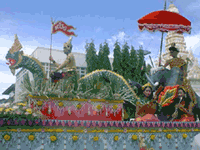
Besides the well-known Loi Krathong Festival, there is another tradition that is based on a similar belief but is celebrated on the full moon night of the eleventh lunar month. Known as the Illuminated Boat Procession , the celebration takes place in the Northeastern provinces of Thailand that is located on the Mekong River. Illuminated boats of approximately 10 – 12 metres long are made from banana stalks or bamboo by villagers. The boats contain sweets, the so-called Khao Tom Mat – stuffed fried sticky rice – and objects to be donated inside, while decorated with flowers, incense sticks, candles, lamps and tinder outside. At present, the boats are created into various shapes such as important places or mythical creatures, which lend a bright and breathtaking sight when the boats illuminated by thousands of lamps are floated onto the river.

The Songkran Festival

Songkran is a Thai traditional New Year which starts on April 13 every year and lasts for 3 days. Songkran festival on April 13 is Maha Songkran Day or the day to mark the end of the old year, April 14 is Wan Nao which is the day after and April 15 is Wan Thaloeng Sok which the New Year begins. At this time, people from the rural areas who are working in the city usually return home to celebrate the festival. Thus, when the time come, Bangkok temporarily turns into a deserted city.

Songkran is a Thai word which means "move" or "change place" as it is the day when the sun changes its position in the zodiac. It is also known as the "Water Festival" as people believe that water will wash away bad luck.

The Songkran tradition is recognized as a valuable custom for the Thai community, society and religions. The value for family is to provide the opportunity for family members to gather in order to express their respects to the elders by pouring scented water onto the hands of their parents and grandparents and to present them gifts including making merits to dedicate the result to their ancestors. The elders in return wish the youngsters good luck and prosperity.
The values for community is to provide the opportunity to create unity in the community such as to jointly acquire merits, to meet each other and to enjoy the entertaining events. And for the society value is to create concern upon environment with cooperation such as to clean houses, temples, public places and official buildings. Thais value the religion bye means of merits acquisition, offerings alms to monks, Dhamma Practice, listening to sermon and monks-bathing.


In the afternoon, after performing a bathing rite for Buddha images and the monks, the celebrants both young and old, joyfully splash water oon each other. The most-talked about celebration takes place in the northern province of Chiang Mai where Songkran is celebrated from April 13 to 15. During this period, people from all parts of the country flock there to enjoy the water festival, to watch the Miss Songkran Contest and the beautiful parades.

Phi Ta Khon Festival


Phi Ta Khon is a type of masked procession celebrated on the first day of a three-day Buddhist merit-making holiday known in Thai as "Boon Pra Wate". The annual festival takes place in *May, June or July at a small town of Dan Sai in the northeastern province of Loei.

Participants of the festival dress up like ghosts and monsters wearing huge masks made carved coconut-tree trunks, topped with a wicker-work sticky-rice steamer. The procession is marked by a lot of music and dancing.

The precise origin of the Phi Ta Khon is unclear. However, it can be traced back to a traditional Buddhist folklore. In the Buddha's next to last life, he was the beloved Prince Vessandorn. The prince was said to go on a long trip for such a long time that his subjects forgot him and even thought that he was already dead. When he suddenly returned, his people were overjoyed. They welcomed him back with a celebration so loud that it even awoke the dead who then joined in all the fun.

From that time onward the faithful came to commemorate the event with ceremonies, celebrations and the donning of ghostly spirit masks. The reasons behind all the events is probably due to the fact that it was held to evoke the annual rains from the heavens by farmers and to bless crops.

On the second day, the villagers dance their way to the temple and fire off the usual bamboo rockets to signal the end of the procession. The festival organisers also hold contests for the best masks, costumes and dancers, and brass plaques are awarded to the winners in each age group. The most popular is the dancing contest.

Then comes the last day of the event, the villagers then gather at the local temple, Wat Ponchai, to listen to the message of the thirteen sermons of the Lord Buddha recited by the local monks.

Then it is time for the revellers to put away their ghostly masks and costumes for another year. From now on, they must again return to the paddy fields to eke out their living through as their forefathers did.

YEEPENG FESTIVAL

Yee Peng is tha annual festival held to celebrate the fulll moon in the northern capital of Chiang Mai on the day preceding Loy Krathong by one day in November.The word "Yee Peng" is the northern Thai term referring to the full moon of the 12 th lunar month in the Buddhist calendar.

The festival is celebrated as a religious event in whichlocal people throughout the region make merit and other religious activities. The highlight of the event focuses on the lunching of the Khom loy or floating lanterns info the night sky with the belief that misfortune will fly away with the lanterns. It is their belief,if the lanterns are made and offered is said to symbolise knowledge and the light it gives will guide them to the right path of their lives.

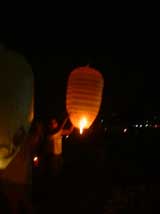
Meanwhile,"Khom loy" is a Thai word signifying the floating lantern which is a large balloon - like made from a light bamboo frame covered with saa(mulberry) paper. It floats by means of hot air heated by a flaming torch fixed in the balloon. During the event, both day and night local people and monks are closely involved with the Khom making process. Besides, the premises of large hotels, the temple compound is thus the appropriate venue for the launching of the Khom. The activity has gained such popularity that at the height of the event the flight training of the Royal Thai Air Force has to be suspended until all the Khom Loy have dispersed while all commercial air traffic at the airport has been warned to exercise extreme caution as the climbing lanterns could pose a danger to the jet turbines.

To celebrate the auspicious event, companies and private individuals make merit by sponsoring balloons to dispel bad luck and seek good fortune. If their balloons rise high and travel far, this indicates prosperity. It has been said that this kind of hot air balloon could rise to heights of up to 1,250 metres and travel even as far as Hat Yai District of the southern province of Songkhla.

The most spectacular event is held at the Thapae Gate area where local and foreign visitors can see floats, marchers and beautiful Yee Peng queens. As the night falls, the spectators will be excited to see the long strings of Khom loy rise gently into the limitless sky as they stimulate the participants' spirits to rise higher to the heaven. This brings joy and happiness to the merit-makers since their ill-fortune has been floated away.

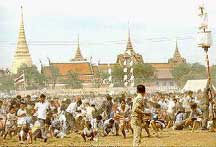
ฺฺฺBANGFIRE ROCKETS FESTIVAL


Rocket Festival or "Boon Bang Fai" in Thai is
usually held in the second week of May of each year, at the beginning
of the rainy season. The farmers are ready to cultivate their paddy
fields. The festival is popularly celebrated in the northeastern
provinces of Yasothorn and Ubon Ratchathani. The celebration is an
entreaty to the rain god for plentiful rains during the coming rice
planting season.
The festival itself owes its beginning to alegend that a rain god named
Vassakan was known for his fascination ofbeing worshipped with fire.
To receive plentiful rains for rice cultivation, the farmers send the
home-made rockets to the heaven wherethe god resided. The festival has
been carried out till these days.

Under the guidance of Buddhist monks, it
takes the villagers weeks to make the rockets, launching platforms and
other decorations. An average rocket is some nine metres in length and
carries 20-25 kilogrammes of gunpowder

In the afternoon of the festival day,
rockets are carried in the procession to the launching site. Villagers
dressed in colourful traditional costumes attract the eyes of the
onlookers, who line up along the procession route.

Before ignition of the rockets, there will be more singing
and dancing to celebrate the festival. The climax of the festival is
the ignition
time. One by one the rockets are fired from the launching platforms.
Each liftoff s greeted by cheers and noisy music. The rocket that
reaches the greatest height is the winner and the owner of this rocket
will dance and urge for rewards on their way home while the owners of
the rockets, that exploded or failed to fly, will be thrown into the
mud. The celebration is a communual affair of the villagers who come to
share joy and happiness together before heading to the paddy fields
where hard work is waiting for them.

Saturday, June 23, 2007

Khon


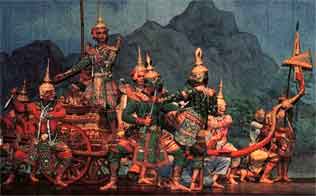
Khon, a performance of which acting and dancing are combined. All methods are identical to those of LAKHON(Acting). Only minor differences make KHON not to be called LAKHON. Dancing in KHON is similar to dancing in LAKHON NAI(Royal act). More pattern of dancing with different actors and melody are adapted to avoid similarity among them.

Main characteristic of KHON is that the performers, except angle, leading male and female performers, have to wear masks.

The masks cover performers’ head '. There are holes, for visibility, at eye position. They are decorated to perfectly portray protagonists’ personalities such as YAK(demon), simian, teva (angel) and others. Masks are decorated with gold, lacquer, and paste jewels. Some people call them “Na Khon”.

The story is proceeded by both rhythmic expressions called “Pak” and rhythmic dialogue. The Pak’s words are Karb Yani (a verse that consists of 11 syllables) and Karb Chabang (a verse that consists of 16 syllables). The dialogues and songs for KHON actors are all recited and sung by, so called, a cheracha man ( a person who speaks out the dialogues for the performers).

Costumes for KHON and LAKHON NAI are identical. The only distinctive item is, naturally, the mask. The masks are in various designs depending on characters and roles. The dress for a leading actor and demon has two colours distinguishing a waistcoat and sleeves. The waistcoat, by this token, represents Armour. For the simian roles, coats and sleeves are designed with pattern of lines rounded in clockwise direction representing hairs. For the demons, there must be a short piece of cloth hanging at the back hem.

The repertoire for KHON is drawn from Ramakien (Ramayana). The KHON performances are categorized as described below.

Khon Klang Plaeng

Khon Klang Planeg is the open-air mask play. Assuming one side of the area to be the city of Lonka, whereas the other side as Phra Ram’s royal quarter, fenced as a imitative camp. There is a 2 m high platform built for a gamelan at each side of stage area. If there is a battle scene at the central zone, the nearer gamelan is responsible to play the music. Khon Klang Plaeng is proceded by recitation and dialogues only.

Khon Nung Rao

Khon Nung rao is performed on the stage at the height of eyesight. The floor is in rectangle shape. The stage is flanked by 3 parts of curtain, which is painted a swell scene of mountain and forests. At outside, on the right of the stage, is a 3 m long with swell paintings of fences and royal quarter of Phra Ram. On the left is a swell painting of a palace and castles, assumed to be the city of Lonka. Two main entrances separating central zone scene and outside scenes. In front of the scene, 1.5 m apart, there is a wooden-tube rail, which is supported by a 60 cm long pole, placed towards the scene. At each end of the stage, there is a 1 m high platform for a gamelan.

The wooden-tube rail serves as seating. When sitting and facing left, the left leg crosses the rail. Do the same when facing right. Phra Ram and his followers sit on the right. Phra Ram himself sits on the far right end of the rail, facing left. His followers orderly sit towards the rail’s mid point. At Lonka side (for the demon) is on the left of the rail. The leader, facing right, sits on the left end of the rail. The followers sit before him, facing left. The non-seated performance can be displayed at all area of the stage. The performance, as in Khon Klang Plaeng, is proceeded by recitation and dialogues only. Forms of dancing are perfectly performed as innovated in the traditional Master of the dance. The performers have to adapt their steps and poses to the recitations and songs of the chorus. The orchestras (gamelan) alternately perform the music from the beginning (Hom rong) to the end of the performance.

Khon Rong Nai

Khon rong Nai is a mixture of Khon and Lakhon Nai. They are both in door performance. A single curtain is used as a scene. There are two exits. A bench is placed near each of them. A gamelan may be, depending on the setting, at the back of each bench or slightly towards the stage.

The performance is proceeded by recitation, dialogue and songs, which are performed by recitators, dialogue man (Cheracha man) and choruses. Similary begin as Lakhon Nai, that is, the leading actor sits on the bench, then carry on his/her dialogue or song as the story proceeds, either as Khon or Lakhon. For example;

When the gamelan is performing Pleng Wa, simians sit at their positions. Phra Ram and Phra Lak sit on the bench. Leading chorus sings Pleng Cha Pee Nai, a swan song, narrative singing. Khon actors return to backstage when final rhythm ends. When the orchestra play Krao Nok ( a classical tune), simian role Khon performers turn up, followed by a crook gang, a simian King, Phra Lak and Phra Ram. Then, Krao Nok dancing is performed, continued with Pak Chom rot and manilulating song.

An important Khon instrument which is distinctive from Lakhon’s, is a royal chariot and a state umbrella, held by an attendant over the leading actor.

It has become the preferred habit for those taking leading roles as well as roles of celestial being not to wear masks since Khon joined with Lakhon Nai, which is called Khon Rong Nai.

Khon Na Chor

Khon Na Chor (mask-play before the scene) is a performance that is identical to Khon Rong Nai. It is only a variety in which the presentation takes place.

The theatre for Khon Na Chor is an adapted version of that for Nung Yai (big screen). Two entrances are added, a bamboo curtain under the screen makes the Khon actor visible for a chorus. The screens outside both entrances are painted; one side is a royal court for Phra Ram, the other is Lon Ka palaces and castles. One bench is placed near each door. The orchestra used to be in front of the choruses who is at the back of the stage.

All types of Khon, from khon klang plaeng to Khon na Chor, has a special musical instrument called “Krong”. Krong is made from big bamboo stems with 3-4 meters long, supported at both ends, 8 centimeters above the floor. 4-5 persons sit in line, holding Krub (a wooden rhythm instrument) in both hands, make the rhythms. Only mirthful songs such as Krao Nok, Krao Nai, or Cherd are performed at the back of the screen. Khon peformers have no participation in the rhythm produced.

Khon Chak

Khon chak is the mask play on the stage. The screen changes as the story proceeds. The method of peformance is the same as Khon Rong Nai. The story is organised to match the already set up scene. If the place has enough space before the curtain for the play, when the curtain is closed, there may be the continuous play before the curtain. So the story is continuously proceeded.

The Royal Ploughing Ceremony

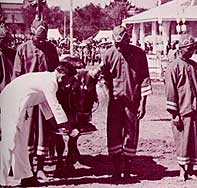
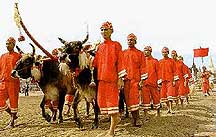
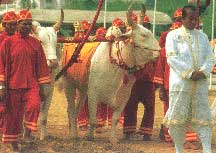
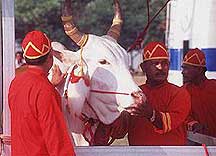
The Royal Ploughing Ceremony was probably, in the old times, the rite designed to remind the farmers and to give an auspicious beginning to the new planting season especially the rice farming that is the major source of food. The leader or the rulers of the country preside over the ceremony when the planting seasons begin. to remind the farmers and to give an auspicious beginning to the new planting season especially the rice farming that is the major source of food. The leader or the rulers of the country preside over the ceremony when the planting seasons begin.

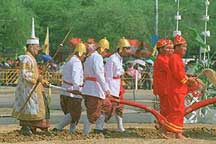
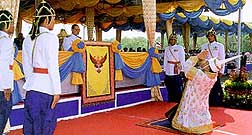
After some times passed, the Brahmanic rite called Ploughing ceremony was then introduced. Its purpose is to encourage the power and happiness. Bhraman were instructors for the ceremony. The king or the leader of the country may designate this duty to a respective high-ranking officer to perform the ceremony as Phraya Raekna, Lord of the Ploughing Ceremony. The roles of the queen or wives who had to help ploughing are designated to four celestial maidens, called the queen of sowing ceremony, assisting Phraya Raekna by carrying seeds containers and distribute the seeds after Phraya Raekna had ploughed the ground. The Royal Ploughing Ceremony has been annually performed for thousands of years in several countries such as China and India.

In Thailand, this ceremony has been performed since Sukhothai was the capital. It had been continued in Ayuthaya and Ratanakhosindhu (Bangkok) period. The Royal Ploughing ceremony performed during the reign of King Rama I, II, and III was purely the Bhramanic rite as it had been in Ayutthaya period i.e. there was no Buddhist monk participated in the ceremony.

In the reign of King Rama IV, the King had royal command to initiate the Buddhist rite together with the original ceremony. The reason was to prosper all the cereals brought into the ceremonial field. After the Buddhist rite that is performed in the first day, the Bhramanic ceremony The combined rite was so called the Royal Ploughing ceremony that lasts for 2 days.

The Royal Ploughing Ceremony is very important and it is a prosperous ceremony to encourage all the farmers.

âThe ancestral masters had set the rule that the ceremony must be performed on the best day of the year, comprising the auspicious occasions as stated in the treatise of astrology. This particular day must also be in the sixth month and the traditional auspiciousness is based on the lunar calendar

The day for Royal Ploghing Ceremony therefore cannot be set in a certain date. However, it is normally in May. The reason that it is required to be in the sixth month is that it is the beginning of raining season. This time is a good time for farmers to start working on their farm, which is an important work of Thai society for a very long time.

After the royal astrologer had already calculated and got the auspicious day for the Royal Ploughing Ceremony, The Bureau of the Royal Households would mark the calculated date into the royal calendar that the king annually gives to his people. The calendar clearly states the date for both rites of the ceremony. The Royal Ploughing ceremony day is announced by the cabinet as a Public holiday but the national flag is raised as it is in usual working days.

The Royal Ploughing Ceremony had been taken place until 2479 B.E. before it had been skipped until 2483 B.E., the year that the government re-announced only the Buddhist rite for cereals was to be taken place at the church in the temple of the Emmerald Buddha.

The Buddhist rite for cereals had been the royal ceremony to encourage auspicious cereals before they were brought to the Royal Ploughing Ceremony. It was conducted a day prior to the ploughing day. The importance of the beginning of the ploughing ceremony was announced on that day

The announcement referred the Buddhist Dharma (the teaching of Buddha) that mentioned the drought was eliminated by the Buddha's power, which caused raining enabling farmers to normally work on their farm. It also mentioned the construction of khanthanraj at the city of khanthanraj. This project was related to the Buddha's power that caused raining. There was then an announcement to honor King Rama I who initiated the construction of Buddha khanthanraj for the Royal Ploughing Ceremony, as this royal ceremony had been conducted by the kings since the old times. The last part was the announcement of wishes for the king altogether with the wish to ask all holy spirits to bless and to protect plants in the kingdom healthily grown with rich of seasonal rainwater. After the announcement, 11 Buddhist monks recite a special chant for the auspicious cereal rite. This chant covers all kind of cereals brought into the ceremonial field. The cereals include rice grains, beans, corns, sesame, pumpkins, melons, taros, and cottons.

In 2503 B.E., the general secretary of the Royal Palace received a royal command regarding the Royal Ploughing Ceremony. The two parts of the ceremony originally had been taken place in two separated days. Later, the ploughing part was skipped. In 2503, the government had decided to reestablish the ploughing part in order to conserve this great traditional royal ceremony for agriculture. The Bureau of the Royal Households and the ministry of agriculture reset this traditional royal ceremony and it has been intact since 2503 B.E. until present. The King Rama IX has been presiding over this royal ceremony every year. He also gave royal wish to the ceremony committee to organize the ceremony contemporary.

The Royal Ploughing ceremony was originally conducted at Phaya Thai rice field. But when the ceremony was reestablished in 2503 B.E., it was then moved to the Sanam Luang Ground that used to be a ceremonial ground in the reign of King Rama I, II, and III. The Phraya Raekna was the minister of agriculture. The four celestial maidens were ladies who work in the royal palace.

Since there were changes, the new duty of Phraya Raekna was then assigned to the director general of rice department, the ministry of agriculture. The four celestial maidens were selected from female officials who worked in the ministry of agriculture.

In the consecutive years until present, the Phraya Raekna duty has been assigned to a permanent undersecretary of the ministry of agriculture and cooperatives. The celestial maidens are selected from single female officials, ranked 3rd-4th levels, who work in the ministry of agriculture.

The Royal Ploughing Ceremony is the ceremonial event that brings auspiciousness to cereals and also encourages farmers to carry out farming works. His Majesty the King has been interested in this ceremony. He has been to the ceremony every year to preside this traditional royal ceremony and to make a wish for prosperity of Thai agriculture. His Majesty the King has conducted the experiment in planting rice in his personal rice field in Chitrlada Villa, Dusit Palace, where he lives. After the harvesting, he kindly gave 40-50 kilograms of rice grains for the ceremony.

The King's rice grains were separated into two portions. The first portion is distributed into the ceremonial ground. The second portion was contained in small packs and sent to provinces of Thailand. Those packs are later distributed to farmers for their auspicious believes and follows the King's wish to encourage and support the agriculture.

Songkran festival


Songkran , regarded as Thai traditional New Year, has been an exotic Thai tradition for generations. Not only Thai people living in Thailand concern importance of Songkran, but also people who speak the language which has the same origin as Thai such as Laotian, Thai people in Myanmar who live near the border at the north of Thailand, and Thai spoken Chinese people in Hunan.

In general, “Songkran” is the word popularly used. But the actual word, in full, is “Troot Songkran” which will be described as follows.

“Troot” means “cut” or “separation” which refers the end or the separation of the year. Therefore, “troot” represents a celebration that the old year is ended and people manage to live throughout the year. Traditional Thai believes regard April as both the month of the old year and the new year. Merit-making on troot days last for 3 days; the fourteenth day of the fourth waning moon, the fifteenth day of the fourth waning moon, and the first day of the new moon. Monks are invited to reprove. Merit-making, food giving are performed, especially to monks. In turn, people get blessed. It is assumed that Thai people are Bhudhism so that they are influenced by this kind of ceremonies as those in Lang Ka.

Songkran means movement or displacement, refers to the Sun is moving into the new year. New year days last from April 13th-15th, annually.

April 13th is called Maha Songkran day.ì April 14th is called Wan Nao , and April 15th is called the beginning of new year day. These may be called differently in the North, but still easy to understand. For example, April 13th, called Sungkarnlong day, means the old body, mind and spirits of the old year are leaving. April 14th, called Wan Nao, April 15th, called Wan Paya Wan, means a first important day of the New Year.

The story of Songkran, as found in historical records at Wat Pra Chetupon, mentioned the origin of Songkran as below.

There was a rich guy who was accused by a drunken neighbour, saying that the rich is useless because it can’t help him to have any children to succeed the family. So the rich guy went to pledge at the riverside banyan tree on Songkran day. Indhra helped him by commanding Dhamabal Dhewabutr to be born in the rich guy’s wife. After his berth, he was named Dhamabal Kumara. His father built a seven-storey tower for him under the banyan tree. Dhamabal was a very wise man. He fisnished his Tripesa when he was only 7 and also knew bird’s language. Kabilabrahma came to test Dhamabal’s intellect by asking him 3 questions. If he could give the right answers, Kabilabrahma would cut off his own head to worship. The questions are:

  1. Where is the morning’s sign of zodiac?
  2. Where is the noon’s sign of zodiac?
  3. Where is the evening’s sign of zodiac?

Kabilabrahma would come to get the answers in 7 days.

On the sixth day, Dhamabal still could not find the answers. So sneaked out to hide at the two big palmyra tree where a couple of eagles live.

In the evening, the female eagle asked her husband where would they get their food on the next day. The male eagle replied that they would eat Dhamabal kumara’s dead body, got killed because he could not gave Kabilabrahma the right answers. The female asked what were the question and the answers. Her husband told her the answers, which were;

  1. The morning’s sign of zodiac is at the face, so that human wash their face in the morning
  2. The noon’s sign of zodiac is at the chest, so that human sprinkle fragrance on their chest
  3. The evening sign of zodiac is at the feet, so that human wash their before they go to bed.

After Dhamabal heard what the eagle said, he rushed back to his tower. On the foolwing day, Kabilabrahma came to ask the questions. Dhamabal gave him the answers he heard from the eagle. Kabilabrahma lost, so he had to cut off his own head as promised. But Kabilabrahma’s head had great supernatural power. If the head fell to the ground, the earth would be on fire. If the head was exposed to the air, there would be bad drought everywhere. If the head was dumped into the water, the ocean would be suddenly dried. Seven daughters must, therefore, use tray to carry the head in the parade around Mount Prasumeru . The head was then kept in Kantabuli cave at Mount Krai Las. When it completes a circle of 365 days or a year, one of the seven daughters had to carry the head of Kabilabrahma in the parade around the Mount Prasumeru. It is appointed that April 13th is Maha Songkran day, the daughter who is assigned on that day had to be a person who carried the head. The assignment is as below ;

  • Sunday : Songkran lady is Tung Sa
  • Monday : Songkran lady is Ko Rak
  • Tuesday : Songkran lady is Rak Sod
  • Wednesday : Songkran lady is Manta
  • Thursday : Songkran lady is Kirinee
  • Friday : Songkran lady is Kimita
  • Saturday : Songkran lady is Mahotorn

Songkran has been a Thai ceremonial tradition for a very long time. From April 13th to April 15th, people perform merit-makings which includes releasing birds and fish, and also bathing monks. People then play water throwing and native sports.

The tradition of releasing fish is a very good activity because it helps a natural reservation. In April, it is very dry and hot. Water resources become dried. Fish gather in small water resources. When these places become completely dry, fish will all die or become other creatures’ pray. Humans help them by bringing them to the river and release them. In raining season, fishes, survived from the drought, come back to breed and become food for humans.

Songkran in Chiang Mai

During Songkran, in the North and Northeast, there are water throwing everywhere. It is common that they stop working for up to 7 days, in some places. The most famous and most fun Songkran celebration is held in Chiang Mai. People of Chiang Mai would do as described here ;

April 13th, called Wan Sungkarnlong, is the day to clean up their houses.

April 14th, called Wan Nao, people will bring food for monks and relatives. This day is the beginning day of the new year. They must not do anything bad, not to speak rude words to others.

April 15th is Wan Paya Wan, regarded as the best day, merit-makings are main activity. There is an organized parade to bathe monks, elderly people and wish for blessing.

The eminence of Chiang Mai, which attracts people to come to play Songkran in Chaing Mai, is that it has a canal surrounding its inner ancient city. People from everywhere gather at the canal around the city, throwing water to people with fun. The other important activity is that Wat (temples) bring their own sacred Buddha images into a remarkable long parade such as a parade of Pra Singha, parade of the white crystal Buddha. These Buddha images are between 700-1000 years old. The parade goes through the center of the city and people can take part in bathing those Buddha images with scented water. Every year, during Songkran, the city of Chiang Mai is packed with people. It can be said that the city is closed for Songkran for the whole 3 days.

Loy Krathong


picture from Thailand Executive Diary 1997 School of Applied Statistics The National Institute of Development Administration (NIDA)ì

Loy Krathong is a thai tradition practiced since the ancient time. Loy Krathong festival begins from the middle of October until the middle of November in the time of high-level river which is full of water. The popular time for the festival is in November full moon shine, because of the full moon. The moon’s light makes the river look clear and clean in the night. The good atmosphere is suitable for Loy Krathong festival.

Loy Krathong was originally called Phraratchaphithi (Royal ceremony) “Jong Plean Chak Kome, Loy Kome”, a Phram Tradition. The purpose was for paying respect to three Gods, Phra Issuan, Phra Narai as well as Phra Phrom.

When Thai People accepted Buddism. Loy Kome Tradition for paying respect to Phra Barommasaririkathat (Buddha’s Relics), Phra Chulamanee in the heaven called Daowadeung was begun. Loy Kome for paying respect to Phraphuthabath was made at the bank of Nummathanthi river, India.

Nang Nophamas, a wife of Phra Ruang who was the King of Sukhothai invented Krathong in the form of lotus and other forms for giving the King. Krathong were released to the river according to the King’s order.In the book called “ Tamrab Taosrichulalak”, the King said “ From today until the future, Kome in the form of lotus are invented eternally by Kings of Thailand on the auspicious day in November full moon shine, to pay respect to Phra Phuthabath Numkathanathi.

In the time of Rattanakosin, the big and elegant Krathong was beatifully made according to a book of Rattanakosin belonging to Chaopraya Thipha Ratchawong

When in November, at the date of fourteen-fifteen waxing moon ,and first waning moon, originally the cousin of the King and government officers with strength were requested to invent the big Krathong of Jong Plean tradition.

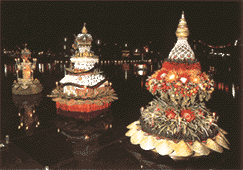
Krathong were made in the form of barrel, Pae Yuak (raft made of banana trees) which was 8-9 sok wide and 10-11 sok high for the purpose of contest. Krathong in the form of Khaosumeru, 4 continents or shelves were sometimes invented. They were decorated with Krueng Sod (decorations of fresh flowers of leaves) by hundreds of people. The expense of Krathong making from the food for these people until experts was nearly 20 chang or more.

At the present, Loy Krathong tradition is held in most of provinces. It is considered to be the annual important festival, especially, the manifestation of big and small Krathong, Krathong as well as Miss Krathong contest are held in Chiangmai.

Loy kome festival is still popular in the north and northeastern of Thailand. Papers will be made for a big colorful Kome. Kome will be released into the air by smoke. But in the night, fire will be set by torch at the mouth of Kome in order to make the smoke go through Kome. After that, Kome will go into the sky. Kome and moon’s light as well as star are beautifully seen in the night.